Hopper
4U Rack Extension · Note Player
Hopper is a note tank. It catches the notes you play and drops each one into a tank that drains in time — one note per step, at a musical rate, in an order you choose. A chord you hold comes out as a line, a ragged flurry comes out even, and a phrase played once keeps coming back — forwards, backwards, by pitch or at random.
- Your notes fall into a tank and drain in time
- Fill it while you play, then take the plug out
- Reshape a phrase: order, rate, chords, odds
// The device
Front & back
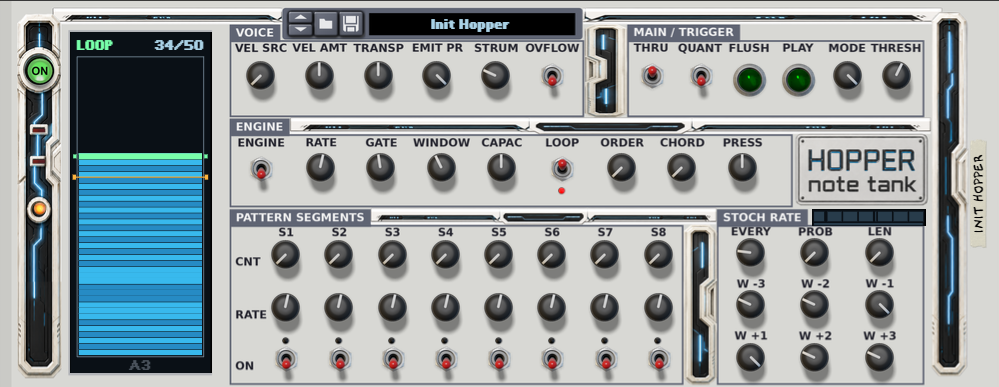
Front panel — the tank display down the left, with the on/off button, activity lamps and fill meter on its rail; Voice and Main / Trigger across the top, the Engine row, and the eight Pattern Segments beside the Stoch Rate dice.
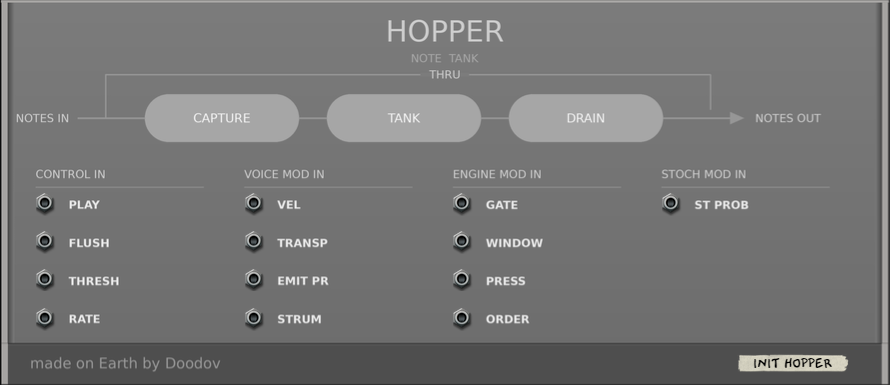
Back panel — a printed map of the signal path and thirteen CV inputs grouped as Control, Voice mod, Engine mod and Stoch mod. Hopper has no CV outputs: its notes go to the instrument below it.
// Overview
A tank for the notes you play
How the tank empties is the other half of the instrument.
Hopper is a Reason Player: it sits above an instrument and catches what you play or sequence. Three trigger modes decide when the tank drains. In Direct it drains as you play, so it works as a rate limiter that evens out a flurry. In Accumulate it fills and waits: tap Play to latch it running, or hold Play to spill only while you hold. In Threshold it fills until the pile reaches a line you drag in the display, then tips itself out.
The drain runs at one of twelve rates from 1/1 to 1/32, dotted and triplet included, free-running or locked to the song grid, with the gate set as a share of the step. Seven orders decide who leaves next — oldest, newest, random, random without repeats, ping-pong, pitch up and pitch down — and switching from Consume to Loop keeps the tank circulating instead of emptying, with a playhead running up the pile. Notes played together are stored as a chord and can leave split, as a block or strummed across the step.
The PATTERN engine walks eight segments, each with its own note count and rate, for uneven phrases no single rate will give you. On top of either engine, Pressure ties the rate to how full the tank is, and the stochastic rate dice nudge it a step or three up or down every few notes, with the odds set weight by weight.
On the way out, notes can keep their played velocity or take a fixed, scaled or randomised one, transpose ±24 semitones, and skip steps by probability while the phrase keeps its timing. Thirteen CV inputs, 52 automatable parameters and 21 patches in seven categories.
// Detail
What's inside
The tank
- 25, 50 or 100 slots; each note keeps its pitch, velocity and chord grouping
- Overflow: Replace drops the oldest note, Freeze protects what is stored
- Flush empties the tank and closes everything sounding, from the panel or CV
Trigger modes
- Direct — drains as you play; with Thru on, your notes pass untouched
- Accumulate — tap Play to latch, hold for a momentary spill
- Threshold — tips out when the fill reaches a 0–100 % line, by knob or by dragging
Drain
- 12 rates from 1/1 to 1/32, dotted and triplet included; free-running or quantised
- Gate 5–100 % of the step; repeated pitches always re-articulate
- Seven orders: FIFO, LIFO, Random, Random without repeat, Ping-pong, Pitch up, Pitch down
- Consume, or Loop with a circulating playhead
Chords
- Capture window 0–50 ms
- Chords leave as Split (one note per step), Chord (a block) or Strum, with adjustable spread
Engines & rate
- SEQ (one rate) or PATTERN: eight segments of 1–8 notes, each with its own rate, on/off switch and lamp
- Pressure bends the rate up to ±3 ladder steps with the tank's fill, in either direction
- Stochastic rate: roll every 1–16 notes, 0–100 % probability, 1–5 note excursions, separate weights for −3 to +3
Voice
- Velocity as played, fixed, scaled (0–200 %) or randomised
- Transpose −24 to +24 semitones
- Emit probability; skipped steps still consume or advance the loop
Display, CV & patches
- Tank column with chord blocks, threshold line, loop playhead, count and last drained note; stochastic activity strip
- 13 CV inputs: Play, Flush, Threshold, Rate and nine bipolar modulation inputs
- 52 automatable parameters in seven Combinator groups; 21 patches in seven categories
Format
- 4U Rack Extension — Note Player
- Plays instruments; makes no audio of its own
// Documents & specs
Manuals
A two-page quick start and the complete operation manual — the tank, trigger modes, drain order, engines, pressure and dice, CV, recipes and troubleshooting. PDF.
- Quick start Hopper_Quick_Start.pdf Two pages — first notes in six steps, and how it thinks
- Manual Hopper_Operation_Manual.pdf 19 pages — 18 chapters, with the patch list, CV reference and MIDI CC table