KBN-G
4U Rack Extension · CV Processor
KBN-G is the melodic member of the Kinetic family. The same four bouncing balls, but every wall they strike sounds a pitched note in the scale you choose — each wall split into three zones that climb the scale, so however wild the bouncing gets, the result always lands in key. Each ball is a monophonic voice with its own gate + note output, so KBN-G can play up to four instruments at once.
- Bouncing-ball physics that plays melodies
- 12 pitch zones snap every hit to your scale
- Ratchet trip lines fire scale-run arpeggios
// The device
Front & back
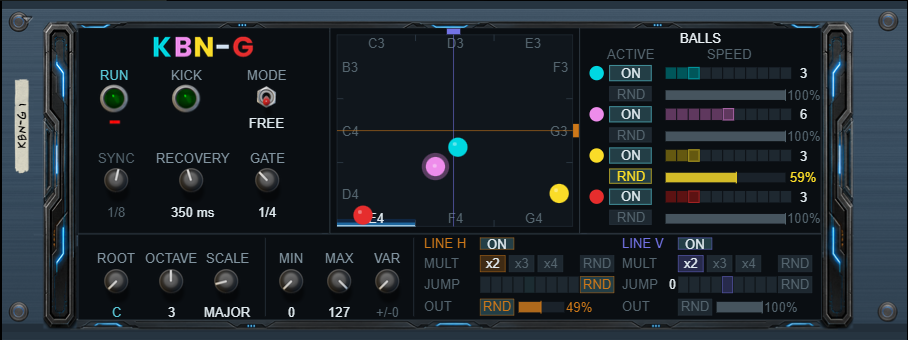
Front panel — Controls left, the Arena centre with a live note label in every zone, the per-ball editor right, and the Pitch / Velocity / Ratchet-Lines strip along the bottom.
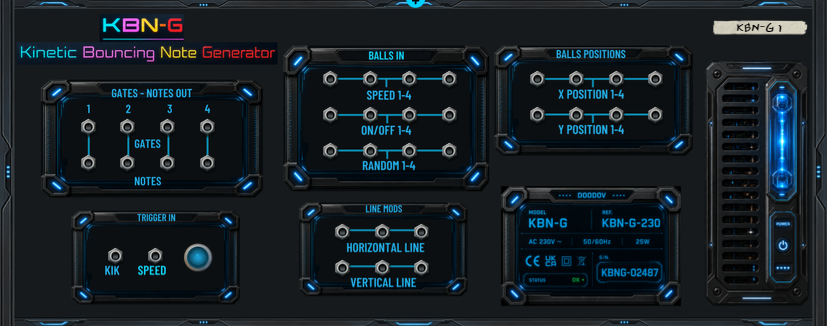
Back panel — the four gate+note voice pairs (Gates – Notes Out) and Trigger In at left, per-ball and trip-line modulation inputs in the middle, ball-position outputs at right.
// Overview
Bouncing balls that play in key
Each wall is divided into three zones — twelve in all — and zone by zone they climb the scale from your chosen root. The arena prints the actual note name in each zone, so you always see what a bounce will play. Ball-to-ball collisions ring the root note as a natural anchor. Pick from ten scales (Major to Whole Tone), any root, and five octaves.
Each of the four balls owns a gate + note CV pair on the back panel — the standard Reason sequencer-control convention — so it plays as an independent monophonic voice. Wire up all four and KBN-G weaves four lines at once. Note velocity tracks impact speed, scaled into a Min/Max window with optional per-hit random variation.
Drop a horizontal or vertical trip line across the field and it becomes a ratchet: a ball crossing it fires a burst of notes laddering up or down the scale, spread across one grid step — instant arpeggios triggered by motion, with control over count, jump and per-note probability.
// Detail
What's inside
The engine
- Four balls in a live physics arena; elastic collisions with energy transfer
- Recovery 50 ms–5 s; Kick re-randomises headings
Pitched output
- Each wall split into 3 zones = 12 ascending scale steps
- Selectable Root (C–B), Octave (1–5) and Scale (10 scales)
- Arena labels every zone with the note it plays
- Collisions ring the Root as a natural anchor
Four voices
- One monophonic voice per ball: a gate + note CV pair
- Drive up to four synths at once for interweaving lines
- Velocity from impact speed; Min / Max window + per-hit variation
Ratchet trip lines (H + V)
- A crossing fires a ratchet burst of notes
- x2 / x3 / x4 count, laddering by a set scale-degree jump (−4…+4)
- Randomise the count, the jump and per-note output probability
- Spread across one grid step, locked to tempo
Timing & chance
- Free (on impact) or Quant (snap to grid) timing
- Musical gate length 1/8, 1/4, 1/2, 1/1 at project tempo
- Per-ball probability thins wall notes; collisions always play
CV & routing
- Inputs: global + per-ball speed, per-ball on/off & random, per-line position / on-off / random, Kick
- Outputs: 4 gate + 4 note pairs, plus 8 ball-position CVs (X/Y)
- Full MIDI CC map; grouped Combinator / Remote targets
Format & footprint
- 4U Rack Extension — CV Processor (helper device)
- Generates CV / notes only — no audio of its own
- State saved with your song; Reason 14 and later
// Documents & specs
Manuals
The complete guide plus a short quick-start — every control, the arena, the CV connections and a set of patch ideas. PDF.
- User manual KBN-G_User_Manual.pdf Cover plus 17 sections — the engine, the 12-zone pitch map, scales, voices, ratchet lines, timing, CV and specs
- Quick start KBN-G_Quick_Start.pdf Two pages — five minutes to your first melody