KGB-G
4U Rack Extension · CV Processor
KGB-G is a physics-driven CV gate generator for Reason. Four balls fly around an arena, ricocheting off the walls and off each other, and every impact fires a velocity-scaled CV gate you can route anywhere in the rack. Free-running or locked to the transport, it turns motion into an organic, ever-evolving stream of triggers — and makes no sound of its own.
- Bouncing-ball physics engine drives the gates
- 9 velocity-scaled CV gates from every impact
- Free-run or lock tight to your tempo grid
// The device
Front & back
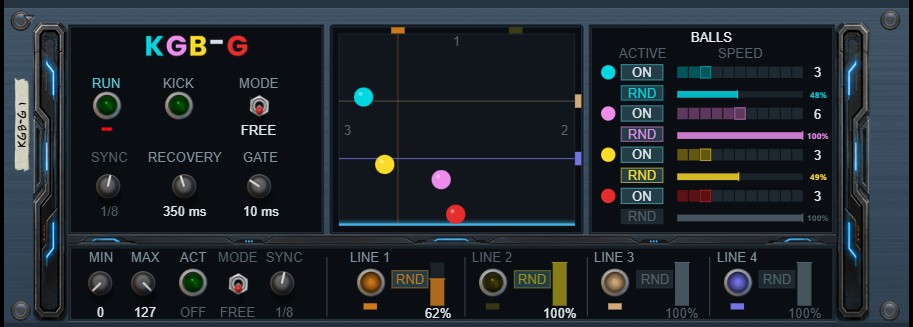
Front panel — Controls (Run, Kick, Mode, Sync, Recovery, Gate) at left, the live physics Arena centre, the per-ball editor right, and the Velocity / trip-line strip along the bottom.
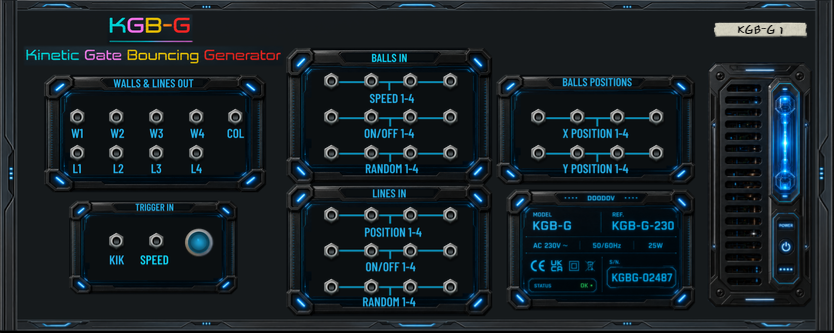
Back panel — Walls & Lines Out (W1–W4, COL, L1–L4) and Trigger In at left, the per-ball and per-line modulation inputs in the middle, ball-position outputs at right.
// Overview
Turn motion into rhythm
Inside KGB-G, four balls carry real momentum: they trade energy when they collide and drift back to a set speed over an adjustable recovery time, so the stream of gates is alive rather than looped. Every wall bounce, ball-to-ball collision and trip-line crossing opens a gate on the matching output.
Nine gate outputs cover the four walls (top, right, left, bottom), ball-to-ball collisions, and four freely-placed trip lines. Each gate's level tracks the ball's speed at impact, scaled into a Velocity Min/Max window — so soft taps and hard slams drive velocity-sensitive sounds differently. Eight more outputs stream each ball's X and Y position as a smooth 0–1 CV for LFO-style modulation.
Patch the gates into drums, envelopes, sequencers or any CV-triggerable device; ride the ball speeds for density, drop a couple of trip lines for extra rhythms, thin the hits with per-ball or per-line probability, and hit Kick for an instant variation.
// Detail
What's inside
The engine
- Four independent balls in a live physics arena
- Elastic ball-to-ball collisions that transfer energy
- Recovery time 50 ms–5 s back to each ball's set speed
- Kick re-randomises every heading for instant variations
Gate outputs (9)
- W1–W4 — wall hits: top, right, left, bottom
- COL — ball-to-ball collisions
- L1–L4 — trip-line crossings (2 vertical, 2 horizontal)
- Gate level tracks impact speed, mapped into the Velocity window
Velocity & timing
- Velocity Min / Max window (0–127) scales every gate
- Gate length 2 ms–500 ms
- Free (fire on impact) or Quant (snap to grid) timing
- Sync grid 1/1–1/32 incl. dotted & triplet; independent grid for the trip lines
Randomness
- Per-ball probability thins each ball's wall hits
- Per-line probability thins each trip line independently
- Collisions always fire — never gated by chance
CV & routing
- Inputs: Kick, global speed, per-ball speed / on-off / random
- Per-line position, on/off and random inputs (draw phantom lines)
- Outputs: 9 gates plus 8 ball-position CVs (X/Y, 0–1)
- Full MIDI CC map; remote targets grouped for the Combinator
Format & footprint
- 4U Rack Extension — CV Processor (helper device)
- Generates CV only — makes no sound of its own
- No patches — the entire state is saved with your song
- Reason 14 and later
// Documents & specs
Manuals
The complete guide plus a short quick-start — every control, the arena, the CV connections and a set of patch ideas. PDF.
- User manual KGB-G_User_Manual.pdf Cover plus 15 sections — the engine, panel-by-panel reference, timing, randomness, back-panel I/O, CV, patch ideas and specs
- Quick start KGB-G_Quick_Start.pdf Two pages — five minutes to your first pattern