Refrain
5U Rack Extension · Instrument · Live looping sampler
Refrain is two instruments sharing one loop buffer. It is a live looper — record to a bar length you choose, overdub, let it decay, and scrub a movable window through the loop — and a slice instrument that plays that same recording from the keyboard, pitched or sliced, three voices at once. Behind both sits a four-ring delay network on a fold-out panel.
- Live looper and slice instrument in one
- Play your loop from the keyboard, three voices
- Four-ring delay with diffusion and pitch spiral
// The device
Front & back
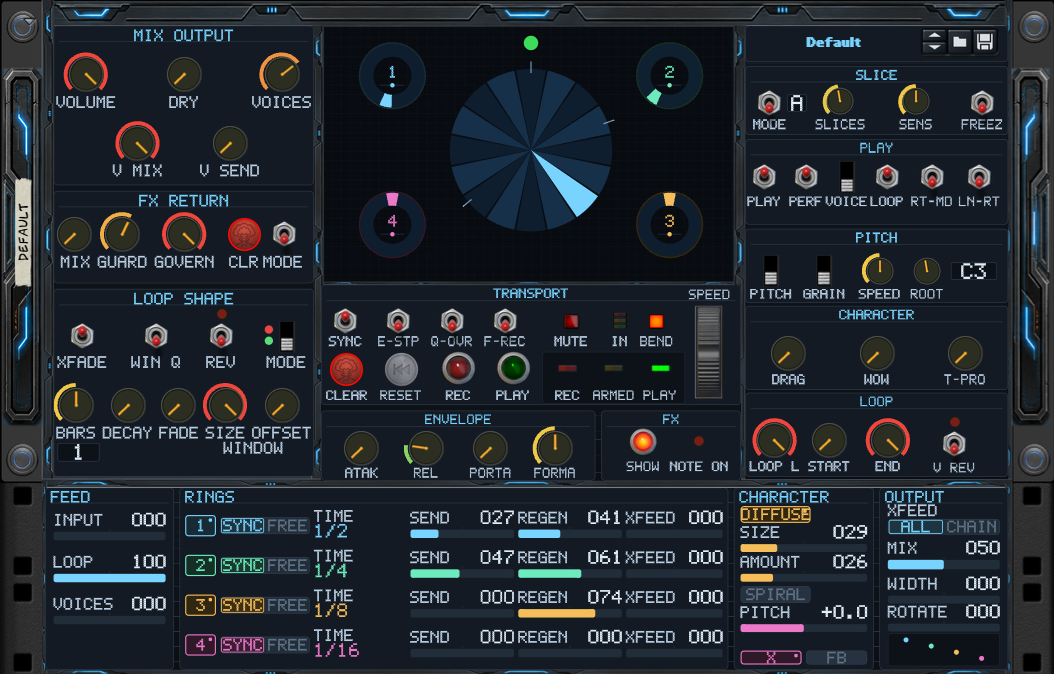
Front panel with the ring delay folded out — mix output, FX return and loop shape on the left; the round loop display, transport and envelope in the centre; patches, slice, play, pitch, character and voice loop on the right; the four delay rings along the bottom.
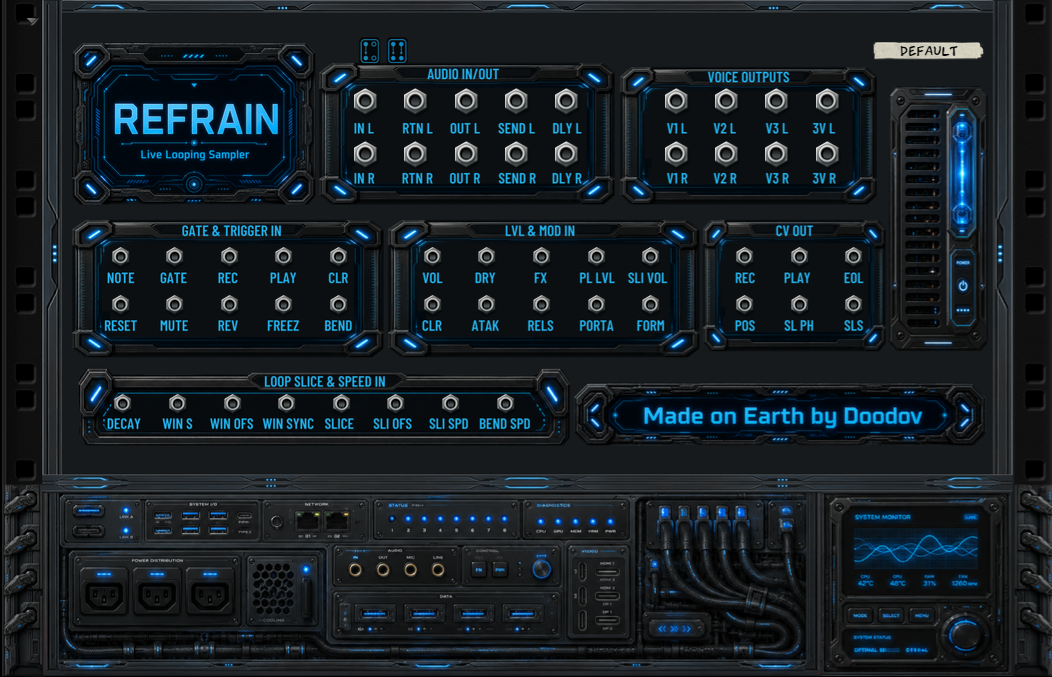
Back panel — main in/out, the effects send/return and a separate delay output, three stereo voice outputs plus a summed pair, and 34 CV sockets grouped by job: gate & trigger in, level & mod in, loop/slice/speed in, and CV out.
// Overview
Play the loop, not just the transport
Record a bar and you can loop it, play it from the keys and feed it into the delay rings — all at once, from the same recording.
As a looper, Refrain records in sync with the transport to a length from a quarter bar up to four bars. F-REC starts a take the instant you press REC, E-STP trims it to the quarter note you stopped on, overdubs can snap to the bar, and DECAY ages the buffer a little on every pass so layers bloom and then dissolve. A movable window — SIZE and OFFSET, with WIN Q to snap it to musical divisions — lets you scrub through your own recording in time, or shrink a bar to a stutter.
As an instrument, the same buffer is playable from the keyboard. Pitch mode maps the whole loop across the keys from a root note; Slice mode assigns one slice per key, up to sixteen, found by transient detection or even division, with FREEZ to lock the map while you overdub. Three voices — Poly, Mono, Legato or Retrigger — each with its own envelope, formant control and stereo output pair, pitched by the Tape, Time or Pro algorithm. The voices read the buffer through their own region controls, so you can scrub the loop while the slices you are playing stay exactly where they are.
Press SHOW and the ring network folds out: four delay rings, synced from 4/1 down to 1/32 or free in milliseconds, fed from the input, the loop, the voices or any blend. Share a bus and every ring hears the others; chain them and each feeds only the next. Diffuse and Spiral sit inside the feedback, so repeats smear into a reverb tail or climb and fall in pitch, and Guard and Govern keep high regeneration musical rather than limiting how far you can push it.
Nothing waits for a mouse: transport, window and slice parameters are all under CV, and CV outputs report record and play state, end of loop, playhead position, slice phase and slice count. An idle instance stops processing until signal returns, and switched-off rings cost nothing.
Refrain is the looping sampler of the LooLoo family — its looper is built on the same engine as LooLoo Mini, and its voice engine shares its roots with the Splitfire samplers.
// Detail
What's inside
Looper
- Loop lengths of 1/4, 1/2, 3/4, 1, 2, 3 or 4 bars, in sync with the transport
- Free record, early stop, and overdub optionally quantised to the bar
- Decay on every pass; reverse; loop crossfade and fade time
- Play, Overdub and Solo modes; speed-bend wheel; click-free clear
Playback window
- Size and Offset choose how much of the loop plays, and where
- Window quantise snaps movement to musical divisions, or lets it move freely
- Shapes loop playback only — the voices have their own region controls
Slice instrument
- Three voices, each an independent reader of the loop buffer
- Pitch mode across the keyboard from a root note, or Slice mode with up to 16 slices
- Auto slicing with transient sensitivity, or even division; Freeze locks the slice map
- Poly, Mono, Legato and Retrigger; On Note and Real Time performance modes
- Per voice: loop, start and end region, reverse, attack, release, portamento and formant
Pitch & character
- Tape, Time and Pro pitch algorithms; grain density Sparse, Medium or Dense
- Drag, Wow and Time/Pro blend for tape-style ageing
Four-ring delay network
- Four rings on a fold-out panel: sync or free time, send, regeneration and cross-feed each
- Independent feeds from input, loop and voices
- Cross-feed as a shared bus or a 1→2→3→4→1 chain; dry/wet, width and stereo rotation
- Diffuse (size, amount) and Spiral (±12 semitones per pass, on feedback, cross-feed or both) inside the feedback
Mix & FX return
- Loop, dry and voice levels, with voice mix and voice send
- FX return in Send or Inject mode; Guard and Govern; clear FX tails without touching the loop
Back panel
- Audio: stereo in and out, effects send/return, delay out, three voice pairs and a summed voice pair
- 28 CV inputs: note and gate, transport, reverse, freeze and bend; levels and envelope; window, slice and speed
- 6 CV outputs: record, play, end of loop, playhead position, slice phase and slice count
Patches & format
- 26 factory patches in six categories, from Basics to Experimental
- No patch stores a held transport button — loading one never records or clears
- 5U Rack Extension — Instrument, with the ring delay on a fold-out panel
// Documents & specs
Manuals
A quick start that takes you from first loop to first ring sound, and the complete operation manual. PDF.
- Quick start Refrain_Quick_Start.pdf Eight pages — record, play the loop from the keys, open the delay rings
- Manual Refrain_Operation_Manual.pdf 21 pages — every control, the ring network, the CV specification, the patch bank and a parameter reference