Splitfire Rubato
4U Rack Extension · Live sampler
Splitfire Rubato is the expressive flagship of the Splitfire family — a slice-and-loop performance sampler built for a single delicate phrase. Capture audio in one button press, slice it on its transients, then play it back across the keyboard or re-sequence it slice by slice through three pitch engines, a dual-mode looper, a stutter engine and tape-style character.
- Record, slice and play any audio live
- Three pitch engines: Tape, Time & Pro
- Seamless looping, stutter & tape character
// The device
Front & back
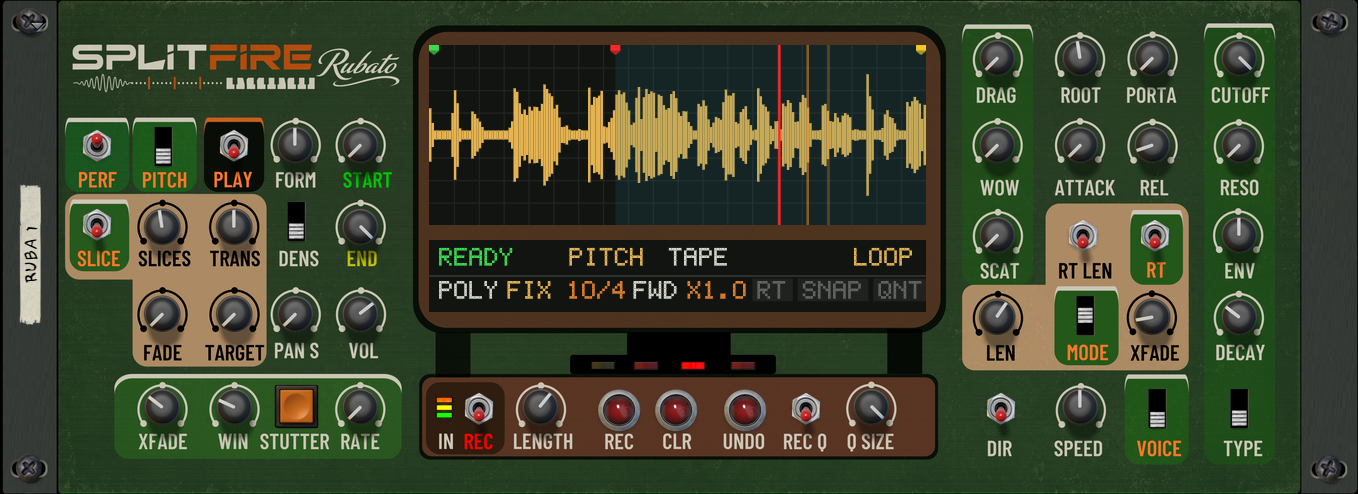
Front panel — record / slice / play and character controls on the left, live waveform and status display in the centre, looper, envelope and multimode filter on the right.
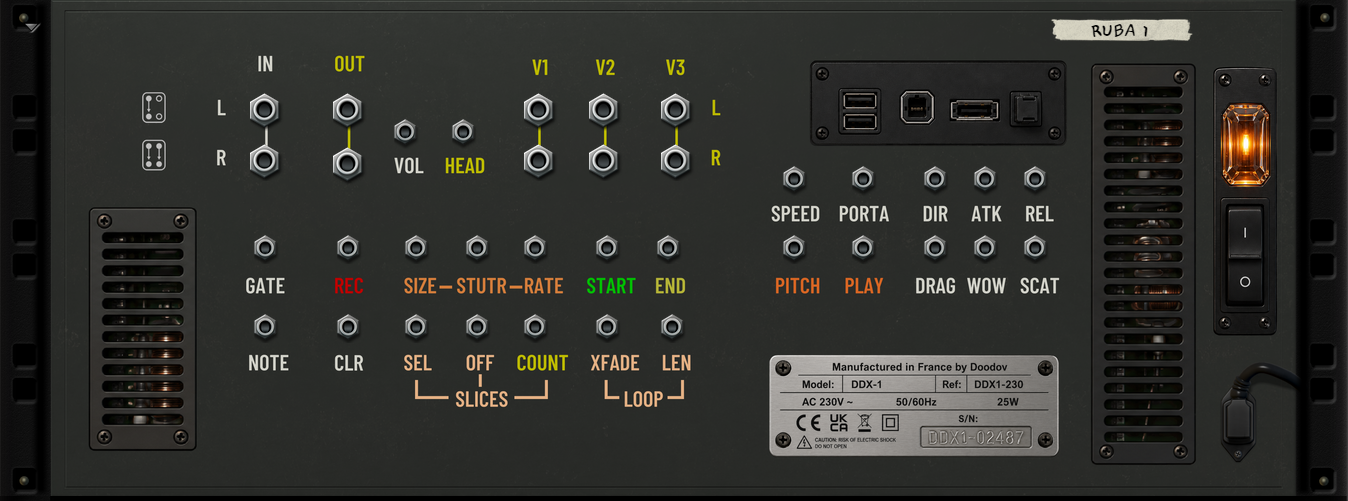
Back panel — stereo audio I/O and per-voice outputs along the top; gates, slice CVs, loop CVs and additive modulation inputs across the lower bands.
// Overview
A flagship built for one phrase
Rubato turns any audio into a playable, performable instrument.
Recording is one button press. Set a length, arm REC, and Rubato captures incoming stereo audio into a generous buffer of around twenty-five seconds. Record Quantize, with a selectable resolution, starts capture on the grid so a take lands in time. The waveform display updates live, and when the take finishes a transient detector divides it into slices — up to sixty-four — shown as markers under the waveform. Undo reverts the last take; Clear empties the buffer.
The captured material plays back two ways. Pitch mode treats the buffer as one instrument, transposed across the keyboard from a settable root, with Start and End defining the playable region. Slice mode maps the detected slices across the keys — and onto the slice CVs — so you can re-sequence a loop, finger-drum hits or scrub through it live. Three pitch engines decide how transposition and speed are rendered: Tape for true varispeed, Time for independent granular time-stretch, and Pro for the cleanest high-fidelity stretching. Formant control and grain density shape the Time and Pro engines.
A dual-mode looper holds notes as tight rhythmic loops or, in Loop X-Fade, as seamless sustained textures with a crossfade across the loop seam. A per-voice stutter engine delivers rolls and glitches from the panel button or a gate CV. Tape-style Drag, Wow and Scatter add the drift, wobble and grit of worn hardware, and an amp envelope plus a multimode filter finish the sound.
Rubato is built to be driven. Gate and note CVs play the engine; record and clear gates and a stutter gate trigger the transport; slice-select, slice-offset and slice-count CVs address the slices; and additive modulation inputs reach speed, portamento, direction, envelope, loop length and crossfade, the character controls and stutter size & rate — with selector CVs that switch the pitch engine and play mode by voltage. Playhead, level and per-voice CV outputs tie Rubato into the rest of the rack. Every parameter is available as a Combinator and automation target, with Record, Clear, Undo and Stutter exposed as remote triggers.
Held notes can follow the controls in real time in Real-Time performance mode, and the voice engine is click-free across every combination of voice mode, play mode and loop mode.
Splitfire Rubato is the expressive flagship in the Splitfire family of live samplers from Doodov, sharing its sampler core with the compact Splitfire Furioso.
// Detail
What's inside
Recording
- Live stereo capture into an internal buffer of approximately 25 seconds
- Adjustable capture length
- Record Quantize with selectable resolution — capture starts on the grid
- Live waveform display with slice markers and a moving playhead
- Undo restores the previous take; Clear empties the buffer
Playback
- Eight voices, polyphonic
- Voice modes: Poly, Mono, Legato, Porta
- Play modes: Pitch (whole take across the keyboard) and Slice (one slice per key / per CV)
- Adjustable play region (start / end), root note, speed and forward/reverse
- Fixed and Real-Time performance modes — held notes can follow the controls live
- Click-free across every combination of voice, play and loop mode
Pitch engines
- Three engines: Tape (varispeed), Time (granular time-stretch), Pro (high-fidelity stretch)
- Formant control for the Time and Pro engines
- Grain density — Character / Smooth / Ultra
Slicing
- Up to 64 slices
- Automatic transient detection with adjustable sensitivity
- Slice onset fade to de-click slice starts
- CV-retarget crossfade for click-free live slice changes
- Slice-select and slice-offset CVs address slices in Mono and Legato modes
Looping
- Three loop modes: Off (one-shot), Loop, and seamless Loop X-Fade
- Adjustable loop length, snapped internally to a quiet point
- Loop crossfade length (Loop X-Fade), capped to keep short loops audible
- Real-time loop-length mode for live changes
Stutter
- Per-voice beat-repeat stutter with adjustable window size, rate and crossfade
- Window size frozen at engage; playback rate modulated live
- Engaged from the panel button or the back-panel gate input
Character & tone
- Tape-style Drag, Wow & flutter, and Scatter
- Amp envelope (attack / release)
- Multimode filter — low-pass / band-pass / high-pass — with cutoff, resonance, envelope amount and decay
- Pan spread across voices, and output volume
CV & routing
- Stereo audio in/out, plus per-voice and playhead / level CV outputs
- Gate and note CV; record and clear gates; stutter gate
- Slice select, slice offset and slice-count CVs
- Additive modulation on speed, portamento, direction, attack, release, start, end, loop length & crossfade, Drag, Wow, Scatter, and stutter size & rate
- Selector CVs for pitch engine and play mode
- Full automation and Combinator support — Record, Clear, Undo and Stutter as remote targets — plus MIDI CC mapping
Format & footprint
- 4U Rack Extension
- Eight voices, sixty-four slices, around 25 seconds of stereo buffer
- Sample rates 44.1 / 48 / 88.2 / 96 kHz
- Reason 13 and later
// Documents & specs
Manuals
Two PDF manuals — a short getting-started guide and the complete operation manual.
- Getting started Rubato_GettingStarted.pdf 4 pages — record, slice and play your first loop in minutes
- Operation manual Rubato_OperationManual.pdf 14 pages — every control, CV and mode, with troubleshooting and a control reference