Step Farther
4U Rack Extension · CV step sequencer
Step Farther is the 4U flagship of Doodov's step-sequencer line — eight stages of pitch, pulse, gate, ratchet, slide and skip, quantised to thirty scales, opened up with a built-in Random engine and a two-input AUX modulation matrix. It drives any instrument over Pitch and Gate CV, and makes no sound itself.
- Eight stages: pitch, pulse, gate, ratchet, slide
- Built-in Random engine — per-parameter chance & window, re-rolled every 1–10 cycles
- 30 scales, 16 directions, AUX A/B matrix, 80+ CV inputs
// The device
Front & back
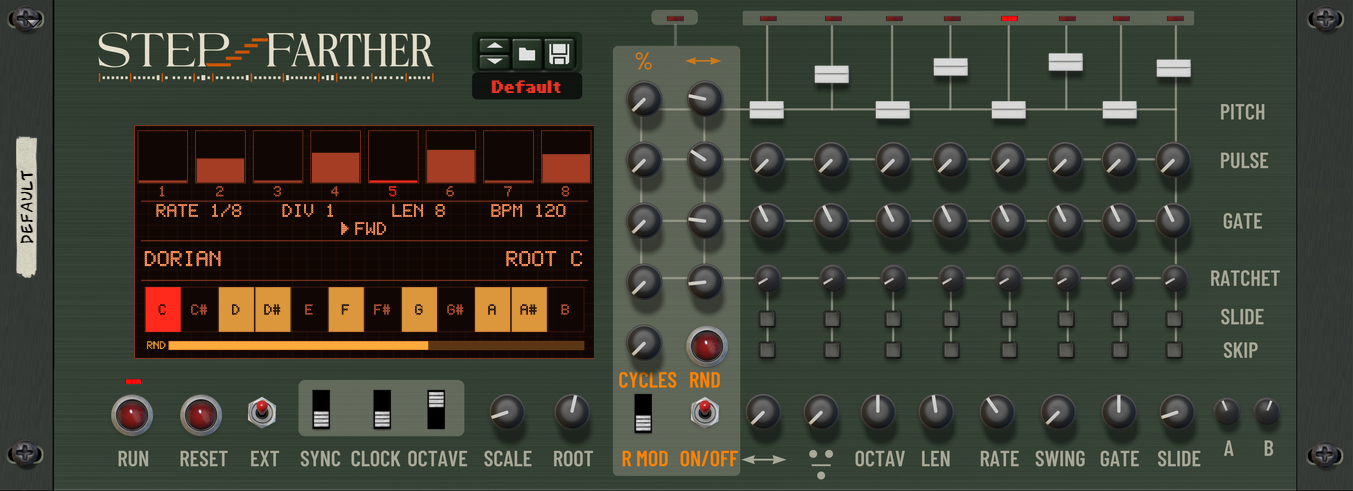
Front panel — patch browser and logo top-left, the green LCD with stage bars and the live scale keyboard, the central Random panel (%, cycles, mode), transport and global knobs below, and the eight per-stage columns (pitch, pulse, gate, ratchet, slide/skip) at right.
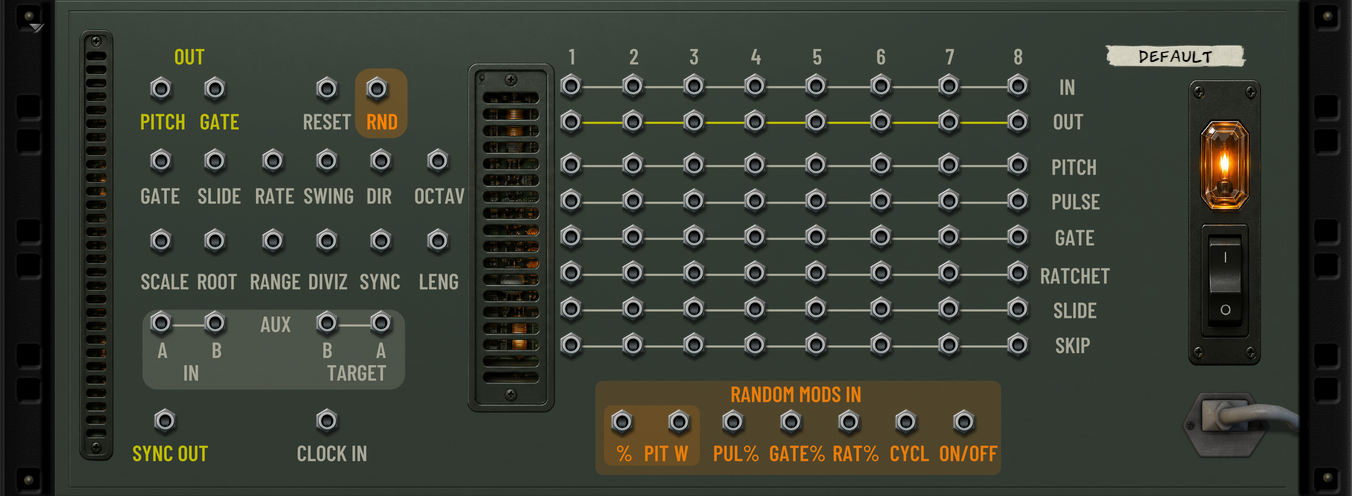
Back panel — Pitch / Gate / Sync outputs and the global and AUX inputs at left, the per-stage modulation matrix and external-pitch inputs centre, the Random Mods In row below, and the direct per-stage pitch outputs.
// Overview
Vintage stages, a generative core
A single column describes a note, how long it lasts, how it's gated and how it slides — then the Random engine keeps it moving.
Step Farther is the 4U flagship of Doodov’s step-sequencer line, built on the same eight-stage engine as Stepling and opened up for generative work. Each of the eight stages carries a pitch, a pulse count of one to eight (how many clock steps the stage holds), a gate mode, a ratchet pattern, and slide and skip switches — so a single column describes a note, how long it lasts, how it articulates and how it slides.
A thirty-scale quantiser keeps everything in key: every pitch snaps to the current scale and root, and a live keyboard on the green LCD lights the notes that belong. Sixteen play directions reshape how the eight stages are traversed — forward, reverse, ping-pong, pendulum, pivot, shuffled, chord-order, Brownian, Drunken and random walks, plus fixed one-step-per-clock variants.
The centre Random engine is what makes Step Farther generative. It applies a per-parameter chance and window to pitch, pulse, gate and ratchet, re-rolling the chosen parameters every one to ten sequence cycles — or on demand from the RND button. A low pitch chance with a two- or three-semitone window adds gentle melodic drift that never leaves the key; open it up for wilder mutation. Every Random control has its own CV input, so the chaos itself can be sequenced.
Two general-purpose AUX inputs route to any of eleven musical targets, selected by the front-panel A and B knobs or by CV — transpose, octave, gate length, slide, swing, rate and more, with scale-locked variants for musical transposition from an LFO. Eleven CV outputs (Pitch, Gate, Sync and a direct pitch output for each of the eight stages) plus 80+ CV inputs let you modulate every parameter and chain units into stacked, self-syncing parts. Unlike the compact Stepling, Step Farther supports patches.
// Detail
What's inside
The eight stages
- Eight stages, each an identical column of controls
- Pitch — quantised to the current scale and root
- Pulse count — 1–8 clock steps per stage
- Gate mode — Hold, Multiple, Single, Rest, Dotted, Random
- Ratchet — 1–4 hits plus Accent, Front, Back, Bounce
- Slide and Skip switches per stage
Pitch & scale
- 30 quantizer scales; 12 root notes
- Pitch span 1, 2 or 3 octaves; global octave transpose ±2 octaves
- Fluid acid-style slide engine
- Live keyboard on the LCD shows the in-key notes, updating with scale and root
Sequencing & directions
- 16 play directions: forward, reverse, ping-pong, pendulum, pivot, shuffled, chord-order, Brownian, Drunken and random, plus fixed variants
- Sequence length and step divider
- Rate with swing; internal or external clock
The Random engine
- Per-parameter chance + window for pitch, pulse, gate and ratchet
- Re-rolls every 1–10 sequence cycles (Cycles), or on demand (RND)
- Mode and on/off; RND bar on the display tracks progress to the next roll
- Every Random parameter has its own CV input (Random Mods In)
AUX modulation
- Two general-purpose CV inputs, AUX A and AUX B
- Each routes to one of 11 targets, chosen by knob or CV
- Defaults: AUX A → transpose, AUX B → octave
- Scale-locked target variants keep modulated pitch in key
CV & routing
- 11 CV outputs — Pitch, Gate, Sync, and a direct pitch output for each of the 8 stages
- 80+ CV inputs — clock / reset / random triggers, AUX A/B and targets, every global and per-stage parameter, 8 external-pitch (slave) inputs, and the Random engine
- Per-stage external pitch inputs let one unit follow another's notes
- Full MIDI CC map; remote targets grouped for the Combinator
Format & footprint
- 4U Rack Extension — CV Processor (helper device)
- Makes no sound on its own; drives any Reason instrument over Pitch / Gate
- Patch support — save and recall complete setups
- Reason 13 and later
// Documents & specs
Manuals
The complete operation manual plus a one-page quick start — every control, the display, the Random engine, AUX routing, the CV connections and patch ideas. PDF.
- Operation manual StepFarther_OperationManual.pdf Complete reference — every control, the Random engine, AUX matrix, CV & chaining, patches and specifications
- Quick start StepFarther_QuickStart.pdf A sequence running in a minute — patching, the display and the stage grid