KBN-C
6U Rack Extension · Note Player
KBN-C, the Kinetic Bouncing Note Catcher, turns the notes you play into bouncing balls. Every note is caught in a ball that launches from the centre of the arena and replays it each time it hits a wall, crosses a trip line or collides with another ball. Up to eight balls share the arena: you choose the pitches, the physics finds the rhythm.
- Every note you play becomes a bouncing ball
- You choose the pitches, physics finds the rhythm
- Eight balls, chord capture, scales and deep CV
// The device
Front & back
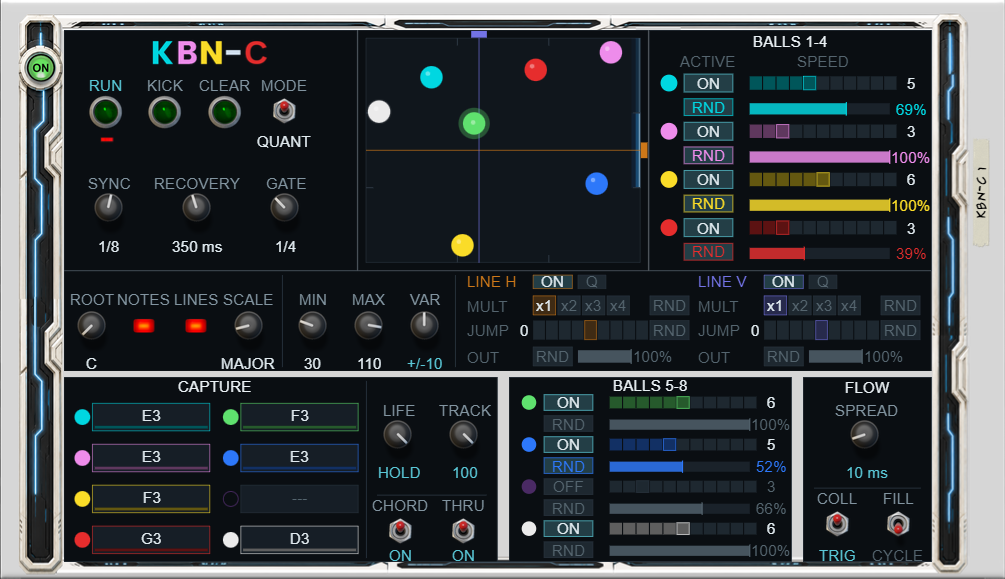
Front panel — Run, Kick, Clear and timing top-left, the arena in the centre and balls 1–4 on the right; root, scale, velocity and the two trip-line panels across the middle; capture cards, Life, Chord and Thru, balls 5–8 and the Flow panel along the bottom.
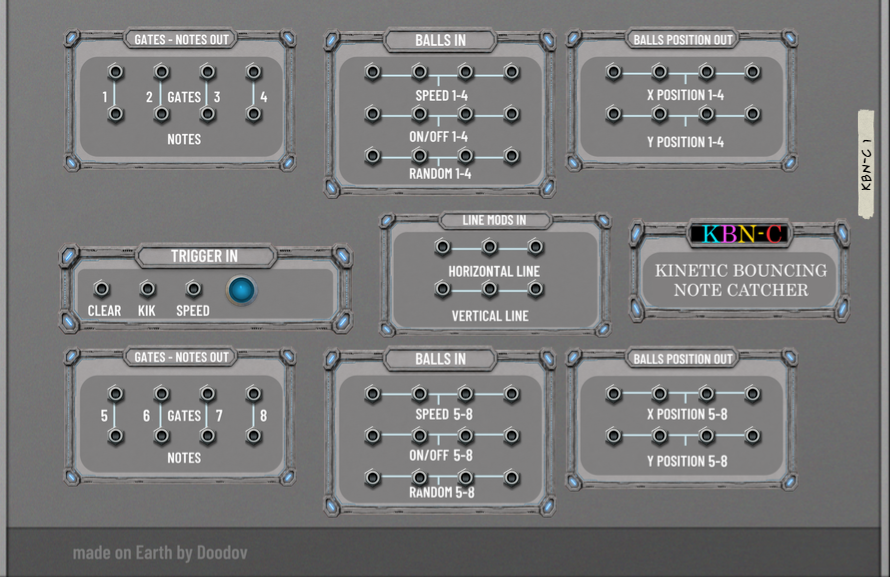
Back panel — a gate + note pair and an X/Y position pair for each of the eight balls, per-ball speed, on/off and random inputs, the Clear, Kick and global speed triggers with the Phantom button, and the line-mod inputs for both trip lines. The notes themselves go to the instrument below KBN-C.
// Overview
Play a note, watch it bounce
Your hands decide what plays — the pitches, the chords, how hard you strike — and the arena decides when.
KBN-C is a Reason Player: it sits above an instrument and catches whatever you play or sequence on its track. Your playing shapes the motion. The pitch of a note sets the launch direction on a chromatic clock — C flies straight up, and every semitone turns the launch 30° further clockwise — and its velocity sets the pace, from half the slot's speed to one and a half times, so hard notes dart and replay louder. Play a chord and up to four notes ride on a single ball.
Each of the eight slots has its own speed and wall-hit probability. Balls live from half a second to a minute, or hold until a newer note replaces them. Play free, following the physics exactly, or quantise every bounce to the song grid; set the gate length, the collision recovery, and whether collisions play or bounce silently. Kick sends every ball off in a new direction, and a soft Clear empties the arena while sounding notes ring out.
Two trip lines, dragged into place in the arena, fire quick bursts of notes stepping up or down the scale when a ball crosses them — free, or started on the grid. Ten scales and twelve roots keep everything in key, with separate switches for correcting captured notes and for the trip-line steps. Spread separates unisons and strums chords, and Thru decides whether you hear your own notes as well as the balls.
Every ball also sends its own gate/note CV pair and X/Y position CV, so KBN-C can play separate monophonic instruments or turn movement into modulation, and 33 CV inputs trigger, speed up, mute and randomise balls and lines from anywhere in the rack.
KBN-C is the fourth member of the Kinetic Generators family. Where KGB-G, KBN-G and KBN-P generate their own events, KBN-C works from yours.
// Detail
What's inside
The Player
- Catches the notes reaching it and plays the instrument below
- Follows Reason's transport start and stop; RUN for standalone play
- Thru passes your own notes to the instrument, or leaves only the balls
- On/Off and Bypass freeze the balls in place; incoming notes always pass through
Capture
- Up to eight balls; when every active slot is full, the oldest ball makes way
- Single notes, or chords of up to four notes per ball (80 ms window)
- Pitch sets launch direction; velocity scales speed from 0.5× to 1.5×
- Life from 0.5 s to 60 s, or Hold; Cycle or First slot fill
Balls & arena
- Per slot: on/off, 11 speed steps and a wall-hit probability (0–100 %)
- Notes from four walls, two trip lines and ball-to-ball collisions (switchable)
- Collision recovery from 50 ms to 5 s; Kick and soft Clear
Timing
- Free, or Quant to 12 grid values from 1/1 to 1/32, dotted and triplet included
- Gate length 1/8, 1/4, 1/2 or a whole note at song tempo
- Spread 0–100 ms: same-note separation and chord strum
Pitch & dynamics
- 12 roots and 10 scales, Chromatic to Whole Tone
- Separate scale snapping for captured notes and for trip-line steps
- Velocity from impact speed: Min/Max range, ±0–20 variation, adjustable tracking
Trip lines (H + V)
- Bursts of 1–4 notes over one grid step, stepping −4…+4
- Random count, random jump and output probability
- Per-line Q starts bursts on the grid
CV
- Outputs: a gate + note pair and X/Y position for each of the eight balls
- 33 inputs: Clear, Kick and global speed; speed, on/off and random per ball; position, on/off and random per line
- Phantom markers show CV-modulated values on the panel
Format
- 6U Rack Extension — Note Player
- Plays instruments; makes no audio of its own
- Every panel parameter except Run, Kick and Clear is automatable and Remote-ready
// Documents & specs
Manuals
A two-page quick start and the complete operation manual — the capture model, the arena, timing, pitch, trip lines, CV, recipes and troubleshooting. PDF.
- Quick start KBN-C_Quick_Start.pdf Two pages — first notes in six steps, and how it thinks
- Manual KBN-C_Operation_Manual.pdf 20 pages — 18 chapters, with the full CV reference and MIDI CC table